
PS PhD Exit Seminar: Pangenomic insights into hybrid success of a wheat fungal pathogen
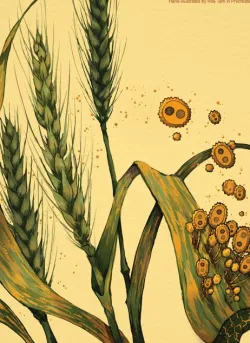
Rust fungi are among the most important groups of plant pathogens, causing substantial losses in agriculture and forestry. Wheat stripe rust, caused by Puccinia striiformis f. sp. tritici (Pst), is a major threat to global wheat production. Its pandemic asexual stage is associated with a dikaryotic genome organisation, in which two distinct haploid nuclei coexist within the same cell. How this unusual genome organisation contributes to its extraordinary capacity for rapid virulence evolution has been challenging to investigate, yet recent advances in long-read sequencing and comparative genomics have enabled these genomes to be studied at detailed nuclear resolution.
Speakers
Event series
Content navigation
Description
ABSTRACT
Rust fungi are among the most important groups of plant pathogens, causing substantial losses in agriculture and forestry. Wheat stripe rust, caused by Puccinia striiformis f. sp. tritici (Pst), is a major threat to global wheat production. Its pandemic asexual stage is associated with a dikaryotic genome organisation, in which two distinct haploid nuclei coexist within the same cell. How this unusual genome organisation contributes to its extraordinary capacity for rapid virulence evolution has been challenging to investigate, yet recent advances in long-read sequencing and comparative genomics have enabled these genomes to be studied at detailed nuclear resolution.
My PhD research investigates the dikaryotic genome biology and virulence evolution of Pst. In this seminar, I will focus on the genomic consequences of hybridisation, and how these may influence virulence evolution. Pst has highly complex reproductive cycles, involving asexual and sexual phases that span distant host plant species and multiple spore types with distinct morphologies and genome organisations. One particularly interesting asexual process is somatic hybridisation, whereby entire nuclei can be exchanged between genetically divergent individuals, generating hybrid offspring with new nuclear combinations. Such nuclear exchange allows to bring together beneficial alleles, such as virulence alleles, for rapid adaptation in the absence of sex. Recent population genomic studies have revealed that global Pst diversity is shaped by two ancestral nuclear types (nuclA and nuclB), whose combinations underpin two homokaryotic populations (AA and BB), as well as globally dominant somatic hybrid populations (AB). The global success of AB hybrids raises questions about the evolutionary advantages of hybridisation, and whether this may resemble heterosis (hybrid vigour), a phenomenon well documented in plants and animals. However, unlike conventional systems whose hybrid genomes are often shaped by historical recombination and introgression, the dikaryotism of Pst presents distinct hybrid genomic outcomes that remain to be fully understood.
In this work, I apply pangenomic approaches to investigate the evolutionary divergence between the two nuclear lineages, and patterns of genome and gene content diversity in parental versus hybrid lineages. The outcomes of this research will provide insights into how hybridisation shapes genome evolution and virulence diversity in rust fungi, with implications for understanding the evolutionary dynamics of one of Australia’s and the world’s most agriculturally important plant pathogens.
BIOGRAPHY
Rita Tam is a PhD candidate in the Schwessinger and Rathjen groups at the Research School of Biology, Australian National University. Her PhD research explores the genome biology and virulence evolution of the wheat stripe rust fungus (Puccinia striiformis f. sp. tritici) using bioinformatics and multi-omic approaches spanning genomics, transcriptomics and epigenetics. Her PhD is supported by RSB International PhD Scholarship, Grains Research and Development Corporation Research Scholarship, and ARC Training Centre for Future Crops Development. Prior to her PhD, she has completed the Bachelor of Genetics at the ANU, followed by an Honours research project on genome-wide association studies and phylogenomics of wheat stem and stripe rust fungi with the Schwessinger group. Outside academia, Rita contributed to SARS-CoV-2 sequencing efforts in the ACT, and currently serves as a council member of the Australasian Mycological Society.
Location
Please note: this seminar will be held in the Eucalyptus Seminar Room, details are included below.
Eucalyptus Seminar Room, S205,
Level 2, RN Robertson Bldg (46)
Please click the link below to join the webinar:
https://anu.zoom.us/j/87929109995?pwd=YlWXcQGUvuXqMcAfC5w66jLDhMRGrN.1
Webinar ID: 879 2910 9995
Passcode: 504100
Canberra time: please check your local time & date if you are watching from elsewhere
Upcoming events in this series

Shou-Wei Ding is a Distinguished Fellow in the School of Life Sciences at the Peking University and a Distinguished Professor Emeritus in the Department of Microbiology and Plant Pathology at the University of California, Riverside.