
PS PhD Exit Seminar: Exploring the role of Aquaporins in wheat responses to water limitation
Water availability and quality strongly affect plant productivity, with drought and salinity disrupting water uptake and cellular homeostasis. Aquaporins (AQPs) are membrane proteins that facilitate the movement of water and small solutes across cellular membranes. However, the contributions that AQPs make to water-stress responses in wheat (Triticum aestivum) remain poorly understood, leaving a knowledge gap that my research seeks to address.
Speakers
Event series
Content navigation
Description
ABSTRACT
Water availability and quality strongly affect plant productivity, with drought and salinity disrupting water uptake and cellular homeostasis. Aquaporins (AQPs) are membrane proteins that facilitate the movement of water and small solutes across cellular membranes. However, the contributions that AQPs make to water-stress responses in wheat (Triticum aestivum) remain poorly understood, leaving a knowledge gap that my research seeks to address.
First, we evaluated twenty diverse wheat genotypes under two contrasting water regimes to quantify variation in physiological, morphological and yield responses. Water limitation substantially reduced plant water status, growth, and productivity to varying extents among the genotypes. Four contrasting genotypes were selected for AQP expression studies using RNA-seq. Differential expression profiling revealed that water limitation induced strong genotype and isoform-specific regulation of AQPs, with varying transcriptional responses among genotypes, demonstrating that AQP regulation under water limitation is not uniform across wheat genetic backgrounds.
Towards investigating potential in planta functional roles, we characterised two AQPs in yeast-based systems to assess their substrate permeability profiles and regulation. Although both were water-permeable, these AQPs differed in their permeability to other substrates, including hydrogen peroxide and ammonium, demonstrating functional specialisation between these isoforms. Testing of phosphorylation mutant versions of these AQPs indicated that post-translational regulation can modify AQP function.
Our observations indicated that AQP stress adaptation contributions would be likely to emerge from the interaction between genotype-dependent transcriptional regulation, membrane localisation, substrate selectivity and post-translational control. By integrating whole-plant phenotypes with AQP transcriptional and functional analysis, my PhD identifies wheat AQPs likely involved in solute transport and drought responses. This knowledge is expected to inform the next steps in testing candidate wheat AQP roles in planta, enabling physiological validation and informing crop improvement strategies for water-limited conditions.
BI0GRAPHY
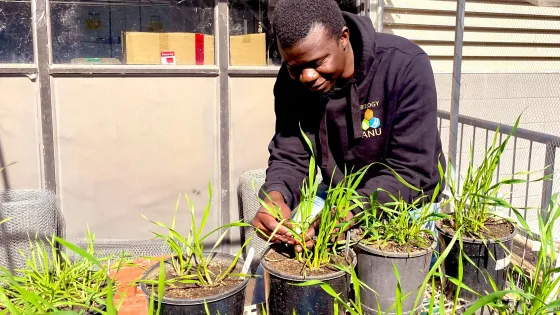
Joseph Esimu is a PhD candidate in the Byrt group at the Research School of Biology, Australian National University. His PhD research, conducted in collaboration with CSIRO, focuses on understanding the physiological and molecular mechanisms underlying drought tolerance in wheat. He holds a BSc (Agri) from Uganda Christian University and an MSc (Agri) from the University of Agricultural Sciences, Bangalore, India. Joseph has extensive experience in plant science research, with a special focus on developing crops tolerant to environmental stresses. His research interests include breeding for stress tolerance, plant-environment interactions, plant stress signalling and adaptation.
Location
Please note: this seminar will be held in the Eucalyptus Seminar Room and via Zoom, details are included below.
Eucalyptus Seminar Room, S205,
Level 2, RN Robertson Bldg (46)
Please click the link below to join the webinar:
https://anu.zoom.us/j/84540158872?pwd=FGa9ogydWA3eRbLqlRu3bF9uQ8cRgM.1
Webinar ID: 845 4015 8872
Passcode: 726286
Canberra time: please check your local time & date if you are watching from elsewhere.
Upcoming events in this series

The Purple Tomato is a groundbreaking example of how biotechnology can translate scientific innovation into real-world impact. This talk traces the journey from fundamental plant science and the development of anthocyanin-rich tomatoes to regulatory approval (including Australia), commercialization, and consumer adoption.

For decades, photorespiration was regarded largely as a wasteful process that lowers photosynthetic efficiency. However, growing evidence points to an additional role in plant defence.