
PS PhD Exit Seminar - Engineering Rubisco and encapsulin nanocages towards enhancing plant carbon fixation
As the key enzyme responsible for inorganic carbon uptake in most photosynthetic organisms, Rubisco exhibits poor catalytic activity and reacts promiscuously with oxygen, limiting the rate of photosynthesis. To offset this limitation, many photosynthetic organisms have evolved carbon-concentrating mechanisms (CCMs) that saturate CO2 near Rubisco, maintaining enzyme function and suppressing oxygenation.
Speakers
Event series
Content navigation
Description
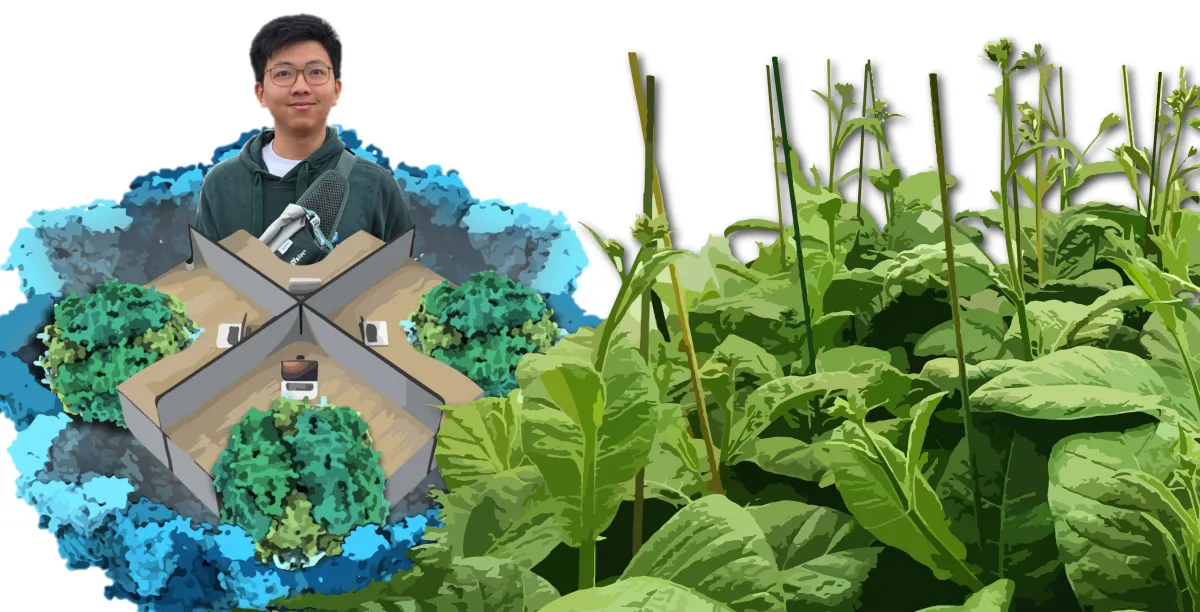
Abstract: As the key enzyme responsible for inorganic carbon uptake in most photosynthetic organisms, Rubisco exhibits poor catalytic activity and reacts promiscuously with oxygen, limiting the rate of photosynthesis. To offset this limitation, many photosynthetic organisms have evolved carbon-concentrating mechanisms (CCMs) that saturate CO2 near Rubisco, maintaining enzyme function and suppressing oxygenation. Efforts to engineer natural CCM systems in crops for yield improvement have been challenging due to their structural intricacy, species-specific constituents, and genetic complexity. The recent discovery of encapsulin – a homomultimeric, self-assembling, and cargo-agnostic protein nanocompartment – offers a promising template for designing a genetically streamlined and modular CCM. This study will follow the four tier processes of developing an encapsulin-based CCM, starting with characterising the plant expression compatibility of faster Rhodobacter sphaeroides Rubisco mutants as encapsulation enzyme candidates. The subsequent study tiers include the generation of carbon-fixing encapsulin prototypes in Escherichia coli containing different Rubisco isoforms, undertaking proof-of-concept plastome transformation strategies to assess encapsulin production in planta, and lastly developing phase separation strategies compatible with housing plant Rubisco within encapsulin cages. These findings provide insight into the tractability of encapsulin-based metabolic systems and lay the groundwork for encapsulin engineering in agriculture, representing critical steps for assembling a complete synthetic CCM within plant chloroplasts towards enhancing carbon fixation.
Biography: I completed my undergraduate degree in Biotechnology and my honours at i3L University in 2021, with an honours project focused on generating genome-based metabolic model to simulate the complex web of interactions within soil microbiomes. After graduation, I briefly worked as a technical officer on insulin production via bacterial fermentation before starting a PhD in the Whitney Lab in 2022. In collaboration with the Lau group from the University of Sydney, my PhD aims to transform encapsulin nanocompartments into a tractable and modular carbon-concentrating mechanisms for eventual implementation in boosting crop yield.
Location
Eucalyptus Seminar Room
S205, Level 2
RN Robertson Building (46)
Please click the link below to join the webinar:
https://anu.zoom.us/j/87883827260?pwd=PUFlZ9aOKk3ANciIey5aNASeYHbbJe.1
Webinar ID - 878 8382 7260
Passcode - 519599
Upcoming events in this series

Plants detect invading pathogens using immune receptors that are located both inside the cell and at its surface. Structural and biochemical studies have transformed our understanding of how intracellular immune receptors recognise effector proteins secreted by pathogens. But far less is known about how plant cell-surface receptors recognise effectors in the apoplast – the space outside the plant cell where many fungal pathogens colonise their hosts.