
E&E Seminar Series: Exploring the ecological drivers of intergroup tolerance in birds
Multilevel societies—where social groups show intergroup tolerance and repeatedly associate and merge with specific other groups—are among the most complex forms of social systems in vertebrates.
Speakers
Event series
Content navigation
Description
ABSTRACT
Multilevel societies—where social groups show intergroup tolerance and repeatedly associate and merge with specific other groups—are among the most complex forms of social systems in vertebrates. They have been described in primates, cetaceans, and ungulates, yet the ecological conditions favouring their emergence remain poorly understood. Birds provide a promising system to address this gap. During my PhD, I proposed a theoretical link between cooperative breeding and the emergence of multilevel societies in birds and showed that superb fairy-wrens (Malurus cyaneus) form such a society, with individuals flexibly adjusting interactions among groups. In this species, intergroup tolerance and cooperation increase under harsher environmental conditions, highlighting the role of environmental variability in extending tolerance and cooperation beyond the group. To test the generality of this framework, I am extending this work to a Neotropical species, the white-winged trumpeter (Psophia leucoptera), examining how environmental variability shapes intergroup interactions in a tropical group-living bird. By combining evidence across contrasting ecosystems, my work aims to identify the ecological conditions under which intergroup tolerance emerges.
BIOGRAPHY

Ettore Camerlenghi is a behavioural ecologist interested in understanding how and why animals form cooperative relationships and how complexity arises from their social interactions. His research combines theoretical approaches with fieldwork to investigate the emergence of complex multilevel animal societies, where individuals form groups that are members of bands, and these bands are organized into clans, similar to most traditional human hunter-gatherer societies. Ettore received his PhD from Monash University (AU) in 2023, where he described the first known multilevel society of a songbird. To address his research questions, he applies hypotheses and theories from anthropology and primatology to birds, which he studies in both Australia and the Peruvian Amazon.
Location
Please note: this seminar will be held in the Eucalyptus Seminar Room and via Zoom, details are included below.
Eucalyptus Seminar Room, S205,
Level 2, RN Robertson Bldg (46)
Please click the link below to join the webinar:
https://anu.zoom.us/j/88339936518?pwd=qELvM6FAwHQ9o6ZuiIOCmCU1q2knav.1
Webinar ID: 883 3993 6518
Passcode: 265683
Canberra time: please check your local time & date if you are watching from elsewhere.
Upcoming events in this series

Pollinators are essential to plant reproduction, community structure, and ecosystem health, but those inhabiting alpine environments face strong thermal constraints.
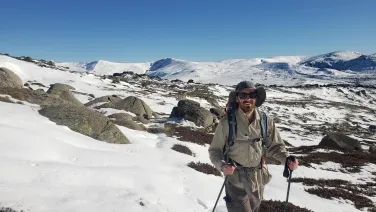
Over the course of my PhD, I have had the pleasure of working in Australia's sub-alpine grasslands investigating the effects of heat and drought on plant functioning and carbon cycling.