
E&E PhD Exit Seminar: How will a hotter, drier future climate affect Australian sub-alpine grasslands?
Over the course of my PhD, I have had the pleasure of working in Australia's sub-alpine grasslands investigating the effects of heat and drought on plant functioning and carbon cycling.
Speakers
Event series
Content navigation
Description
ABSTRACT
Anyone who has spent time in the mountains will know the beauty of alpine grasslands. What they may not know is how important these grasslands are for carbon storage and biodiversity worldwide. Alpine grasslands are predicted to be highly sensitive to the effects of climate change, yet, considerable uncertainty remains as to how severe the impacts will be on plant functioning. Additionally, as large carbon stores, grasslands have the potential to accelerate climate change if this carbon is released back to the atmosphere under a future climate. My PhD explored the effects of heat and drought on Australia’s alpine grasslands from individual plant responses to whole ecosystem functioning. Through a meta-analysis I identified the reasonable likelihood of interactions occurring between heat and drought, highlighting the importance of investigating both factors concurrently as opposed to single factor experiments. Further, I spent three years collecting data in the first in situ soil warming and drought experiment in the southern hemisphere. I identified a shift in plant traits towards a conservative strategy (e.g. more drought tolerant leaves) under heat and drought and observed increased growth of shrubs as opposed to graminoids. This is in line with predictions of woody encroachment into these ecosystems. Finally, I found that soil respiration appeared to acclimate to the warming treatment, yet there was considerable variation between years related to soil moisture. I will discuss the implications of these results in relation to their ability to sequester carbon and what I believe the future holds for these grasslands as they currently stand.
BIOGRAPHY
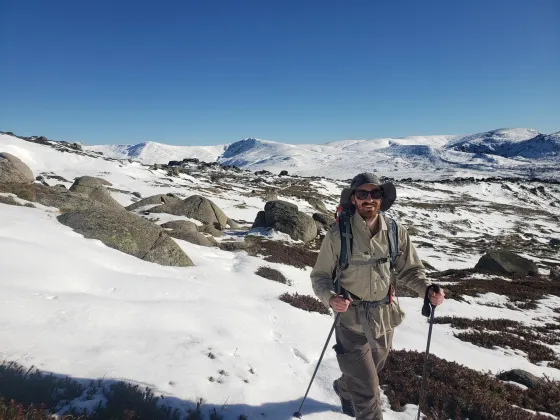
James is a PhD candidate in the Nicotra group. Following a stint working as a lift operator at various ski resorts, James began his undergraduate and developed an interest in botany and ecology. He then found himself working as an ecologist which allowed him to spend most of his time looking for plants and birds outdoors. However, after a couple of years of work, he decided it was time to be a poor student again and went in search for a PhD topic. Perusing the webpages of lab groups from universities all over Australia, he found a couple of supervisors who appeared to work together in the alpine, but most importantly had pictures of themselves skiing as part of conducting their research! Knowing very little about the project, he applied and promptly moved interstate to spend his time “working” in the grasslands in Kosciuszko National Park. He is broadly interested in plant ecology and in particular, the way in which plants interact with their environment to shape carbon fluxes.
Location
Please note: this seminar will be held in the Eucalyptus Seminar Room and via Zoom, details are included below.
Eucalyptus Seminar Room, S205,
Level 2, RN Robertson Bldg (46)
Please click the link below to join the webinar:
https://anu.zoom.us/j/87268347656?pwd=SeMwEiJaIxWPiaXvTnfaOQNKj99UK0.1
Webinar ID: 872 6834 7656
Passcode: 851485
Canberra time: please check your local time & date if you are watching from elsewhere.
Upcoming events in this series

Over the last three years of my PhD, I have been working with Anangu researching why ecologically and culturally significant plants are dying during extreme heatwaves and drought

Pollinators are essential to plant reproduction, community structure, and ecosystem health, but those inhabiting alpine environments face strong thermal constraints.