

October Newsletter: Issue 172
From the Director
Dear colleagues,
In this month’s newsletter, we celebrate success of RSB Faculty in the competition for ARC Discovery Grants - congratulations to the funded and commiserations to those that missed out. Here I want to acknowledge the superb support provided by our Research Management team, who shepherded 29 EoIs, then 14 internally-led proposals resulting in 7 awards (~$6.4M total), additional to participation in 5 externally led DPs ($4.3M total). In the midst of all this, our Research Management Team along with Charlie Morgan (RDS, RSB) have just supported submission of 11(!) 2026 Future Fellowship proposals from RSB (and 13 more from other schools). Without the efforts of the RM Team, RSB Faculty would be simply unable to maintain our strong performance in winning competitive grants. Drop by and say thanks to them when you get the chance!
I am also pleased to note that RSB Faculty continue to step up for important leadership and service roles. Over the past month we’ve been notified that two staff - Michael Jennions (E&E) and Benjamin Schwessinger (PS) - have been appointed to the ARC College of Experts, joining Adrienne Nicotra (E&E) in this important role. Additionally, Sasha Mikheyev (E&E) has won the election as a staff representative on ANU Council, to which I am sure he will contribute strongly. Watch this space…
Finally, we are once again coming to the end of another teaching semester and year. I know that many Faculty, having completed teaching, are in the midst of grading exams and finalising results. In the background our AD Education Maja Adamska (BSB) continues to steer the teaching ship though troubled waters, as does AD HDR Celeste Linde (E&E) for our HDR program.
My thanks to you all for making RSB such a strong school in research, training and teaching.
Welcome
Fahim Nawaz

APPN- ANU welcomes Fahim Nawaz as a Technical Officer, primarily working on the NSW DPIRD/GRDC Canola project. Fahim is an experienced crop physiologist and has been working in the Furbank Lab since 2023. Before that, he worked at the University of Hohenheim, Germany, on the European Union’s Horizon 2020 SolACE project, and on a Biotechnology and Biological Sciences Research Council (BBSRC) project at the University of Oxford, United Kingdom. He holds a PhD from the University of Agriculture, Pakistan.
Farewell
John Tanner
Farewell to John Tanner (BSB, Corry Lab) who is moving to the University of Newcastle to start a Postdoc with Alister Paige, developing high-throughput virtual screens of existing drugs for novel ovarian cancer treatments. John recently submitted his PhD, investigating how proteins in the malaria parasite evolve to generate resistance to drugs — helping inform strategies to reduce the occurrence of drug resistance. John's ability to consider how molecular details of membrane transport can have global health consequences will be greatly missed; as will his unique view on life and ability to recreate the Joker dance. Wishing you all the best in Newcastle! #teammalaria

Grants Awarded
Ashley Jones (Schwessinger Group, PS) was awarded a Eucalypt Australia research grant valued at $50,000 for his proposal to develop a comprehensive Eucalyptus pangenome resource that will map genetic diversity across species to identify traits that help trees adapt to climate change.
Australian Research Council Discovery Project 2026 outcomes announcement saw several successful RSB applicants:
- Megan Head (E&E), Chris Reid (Macquarie University) Does metamorphosis facilitate or constrain adaptation to new environments?
- Scott Keogh (E&E), Ian Brennan (Keogh Group, E&E), Mitzy Pepper (E&E), Carlos Pavon Vazquez (former Keogh Group, E&E) Disentangling the Drivers of Australian Animal Diversity.
- Scott Keogh (E&E), Phillip Byrne (University of Wollongong), Marta Vidal-Garcia (former Keogh Group, E&E) Linking Ecology and Evolution to Protect Australian Frogs.
- Rob Lanfear (E&E) Precision Phylogenomics: accurately inferring the tree of life.
- Rod Peakall (E&E), Darren Wong (Peakall Group, E&E), Benjamin Schwessinger (PS), Philipp Schlüter (University of Hohenheim), David Chagné (BSI) Adaptation, evolution and conservation of Australia's diverse orchids.
- Melanie Rug (CAM), Alexander Maier (BSB) Deciphering lipid droplet dynamics and function in malaria parasites.
- Danielle Way (PS), Juergen Knauer (University of Technology Sydney) Improving the representation of C4 photosynthesis in vegetation models.
- Giel van Dooren (BSB), Adele Lehane (BSB) How do intracellular parasites adapt to changes in nutrient availability?
Congratulations also to Denisse Leyton (BSB), Adrienne Nicotra (E&E) and Spencer Whitney (PS) who were the ANU CIs on successful externally led Discovery Project applications.
Awards
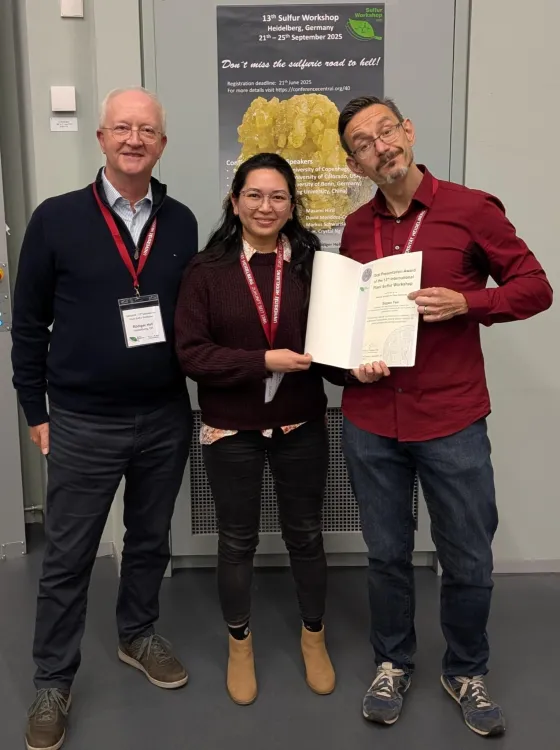
Congratulations to Suyan Yee (Chan Group, PS) who won the best ECR presentation award for her talk at the 13th Plant Sulfur Workshop in Heidelberg, Germany.
News
Caitlin Byrt (PS) and Ben Long (Byrt Group, PS) had a submission accepted into the Senate Standing Committee on Environment and Communications Algal Blooms in South Australia enquiry, Submissions – Parliament of Australia: titled 'Feeding the Bloom: The role of CO2, nutrients, and heat in algal proliferation'.

International Safe Cassava Network 2025 Symposium Day 1 Recording
Over 150 people from at least 37 countries attended the inaugural virtual Safe Cassava Symposium, organised by members of the International Safe Cassava Network. Speakers summarised the current state of knowledge and presented new research on cassava and the diseases associated with its toxicity, especially Konzo, from a multidisciplinary perspective. The Network replaces the Cyanide in Cassava Disease Network established by the late Dr Howard Bradbury AM through the ANU. Prof Ros Gleadow (Monash University and visiting ANU fellow) chaired the steering committee. The organisers thank the Global Plant Council and the Konzo Prevention Unit for their support. Attendees were invited to donate to the Konzo Prevention Fund. Watch Day 2 of the Safe Cassava Symposium on YouTube or make a donation to the Konzo Prevention Fund on the Konzo Prevention Unit webpage.
In the Media

Caitlin Byrt (PS) presenting at the Cicada x Tech23 event
RSB's biotech start-up Membrane Transport Engineers (MTE), Caitlin Byrt (PS), Annamaria De Rosa (Byrt Group, PS) and Samantha McGaughey (Byrt Group, PS), shared a presentation at Australia's biggest deep tech innovation event, Cicada x Tech23 in Sydney. MTE tech is designed to support the transition to a circular economy, effectively transforming industrial waste into valuable resources for essential sectors such as agriculture, mining, and clean energy. Read the latest MTE publication for more information: Australian Centre for Geomechanics | Conference Paper: Bioderived element resource separation technology for waste processing.
Congratulations to Hannah Carle (PhD 2023 with Adrienne Nicotra and Patrick Meir) whose PhD work was published this week in Nature and has attracted a storm of media attention in Australia and around the world. The work demonstrates that in Australia’s tropical rainforests a transition from carbon sink to source occurred for the aboveground woody biomass of these forests in the past 25 years. The transition was driven by increasingly extreme temperature and other climate anomalies, which have increased tree mortality and associated biomass losses, with no evidence of the carbon fertilization (stimulation) of woody tree growth. Read The Conversation article A crucial store of carbon in Australia’s tropical forests has switched from carbon sink to carbon source, or similar articles by The Independent, The Guardian, News.com.au, BBC, Phys.org and YahooNews. Read articles in Spanish by La Razón, La Vanguardia and RFI. Read articles in French by IRD website, Sud Ouest, La Croix and for our Portuguese readers, the following article by GameNexus.
RSB Spotlight
Plant Sciences
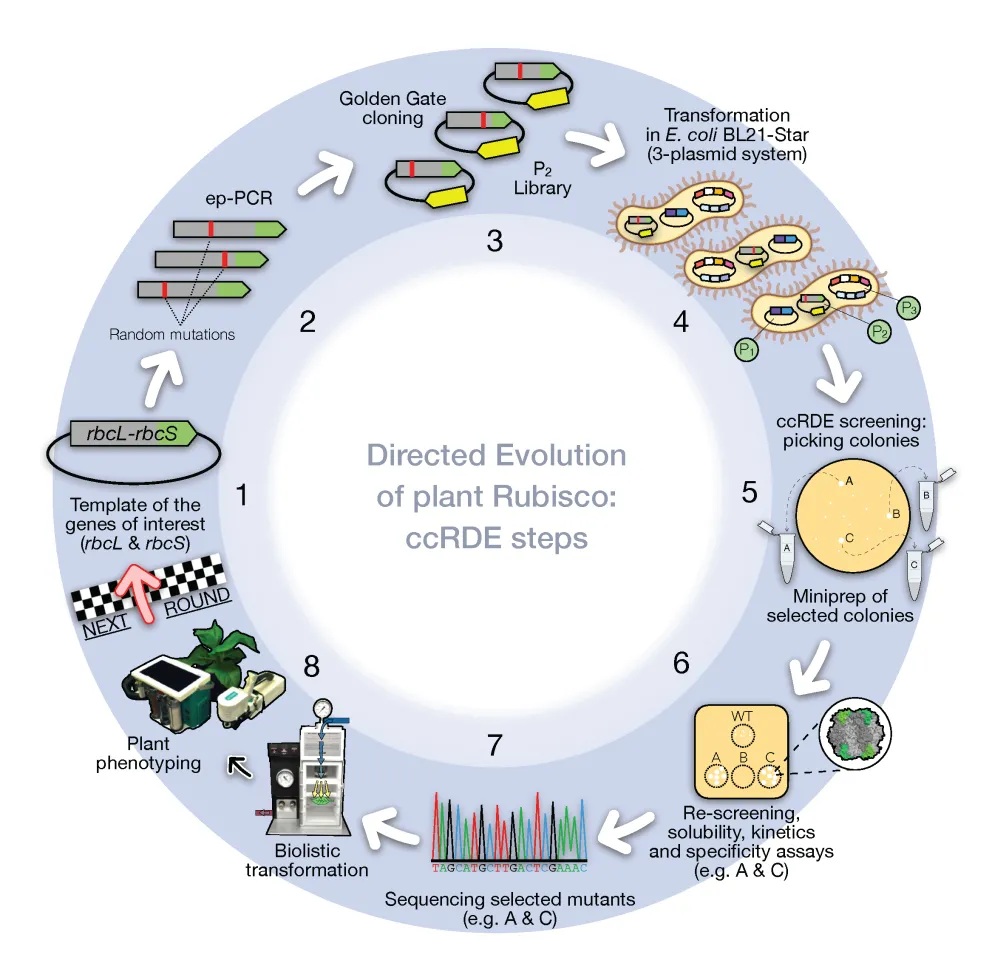
All organic carbon entering our food chain is captured by the carbon dioxide fixing enzyme Rubisco during photosynthesis. Although Rubisco is the most abundant enzyme on our planet, it is far from a perfect catalyst. In addition to being extremely slow, Rubisco can mistake O2 for CO2 leading to the production of a toxic product whose recycling into something useful can impair plant productivity by up to 30%. As a result, improving plant growth by engineering of Rubisco has been a longstanding challenge. Despite significant efforts from both academic and commercial research groups over five decades, success has been limited due to the enzyme’s complex structure and function. Now, using new synthetic biology tools developed in the Whitney Group (PS), a team of PhD students led by Matteo Gionfriddo (Former Whitney Group, PS) have a sniff of success. Using directed evolution and gene editing of the chloroplast genome, the team discovered two genetic tweaks in plant Rubisco that allow the enzyme to fix more CO2 and help some plants grow faster. The work, published in Nature Plants, showed how one of the discovered mutations universally boosted the catalytic speed of all plant Rubiscos, while the other mutation helped the enzyme to fold properly and be produced in larger amounts. As predicted from photosynthetic assimilation models, while neither of the changes impacted the growth of tobacco, when introduced into hybrid versions of Rubisco, significant improvements in plant growth and photosynthesis were achieved. The research provides a pioneering example of how lab-based evolution and synthetic biology can help develop more productive crops for the future.
In another associated study, published in PNAS, Spencer Whitney (PS) and Sarah Kaines (Whitney Group, PS) worked with colleagues at MIT (USA) to develop a new E. coli continuous directed evolution system to select for forms of Rubisco with reduced sensitivities to O2 inhibition. Rubisco from Gallionellaceae bacteria was chosen for this proof-of-concept study as, although being the fastest known Rubisco on earth (six times faster than plant Rubiscos), it is extremely sensitive to oxygen inhibition because these bacteria are adapted to living in low oxygen environments. The work demonstrated how within the period of only a few weeks, the continuous Rubisco evolution system was able to successfully select for versions of Rubisco with substantial improvements in their CO2-fixing rates under atmospheric oxygen concentrations. Current sights are on emulating such catalytic gains in plant Rubisco to boost crop carbon capture and productivity.
Taking an alternative approach to boosting Rubisco activity, the Whitney Group has collaborated with A/Prof Yu Heng Lau’s research group at The University of Sydney to develop a way to package any forms of Rubisco into tiny protein cages derived from bacterial encapsulin to produce fully functional CO2-fixing nanoreactors. The research, published in Nature Communications, demonstrates a new pathway for building a CO2-concentrating mechanism that is simpler than the Rubisco containing compartments currently found in natural (such as cyanobacteria carboxysomes and algae pyrenoids). The next step is to test the Rubisco packing system in plant chloroplasts, something already initiated by RSB PhD student Davin Wijaya (Whitney Group, PS), the co-first author on the paper.
Gionfriddo M, Birch R, Rhodes T, Buck S, Skinner T, Andersson I and Whitney S (2025) Laboratory evolution of Rubisco solubility and catalytic switches to enhance plant productivity. Nature Plants 11, 1939–1950
McDonald JL, Shapiro NP, Mengiste AA, Kaines S, Whitney SM, Wilson RH, Shoulders MD (2025) In vivo directed evolution of an ultrafast Rubisco from a semianaerobic environment imparts oxygen resistance. Proc Natl Acad Sci U S A. 122, e2505083122.
Szyszka TN, Wijaya DS, Siddiquee R, Loustau A, Rhodes T, Paul N, Whitney SM, Lau YH (2025) Reprogramming encapsulins into modular carbon-fixing nanocompartments. Nature Communications, 16, 9493 (2025). https://doi.org/10.1038/s41467-025-65307-9
For the latest media commentary read the following articles:
The Conversation: Engineering crops to photosynthesise better just got one step closer to reality
Phys.org: Synthetic biology to supercharge photosynthesis in crops
Bioengineer.org: Harnessing Synthetic Biology to Turbocharge Photosynthesis in Crop Plants
Publications
Braby MF, Beaver EP & Herd CD. New distribution and larval food plant records of the Bright Forest-blue (Paradipsas cephenes) (Hewitson, 1874)) from eastern Australia. North Queensland Naturalist.
Brandl HB. Valle-Perreira, JVS, Pruessner J.C, Farine, DR et al. Physiological synchrony among human fishers during collective hunting with wild dolphins. Biology Letters.
Buss W, Verburg K, Garba I I, Bentley A R et al. Harnessing biological nitrification inhibition to reduce soil nitrogen losses – Systematic quantification of plant and soil factors to maximise field-scale benefits. Agriculture, Ecosystems and Environment. https://doi.org/10.1016/j.agee.2025.110002
Catitti B, Chan G, Farine D et al. COVID-19 lockdown effects on the foraging strategies of a facultative scavenger. Biology Letters. https://doi.org/10.1098/rsbl.2025.0223.
Jennions MD. Competition for eggs or sperm suffices to define sexual selection: a comment on Janicke (2024). Behavioral Ecology. https://doi.org/10.1093/beheco/araf088.
Korbmacher F, Rauch M, Kenthirapalan S, Kooij TWA, Maier AG & Matuschewski K. Stage-dependent expression and vacuolar localization of Plasmodium berghei chloroquine resistance transporter (CRT). Molecular and Biochemical Parasitology. https://doi.org/10.1016/j.molbiopara.2025.111703
Liao CC, Radford AN, Heinsohn R & Magrath RD. Functionally referential communication about danger in cooperatively breeding white-winged choughs. Animal Behaviour. https://doi.org/10.1016/j.anbehav.2025.123330.
Lorcery M, Husson L, Salles T, Skeels A et al. Deep time evolution of the Latitudinal Diversity Gradient: Insights from mechanistic models. PLoS One. https://doi.org/10.1371/journal.pone.0332766.
Mahmud-Al-Hasan M, Jennions MD & Head ML. Developmental temperature, not inbreeding, shapes life history and locomotor behaviours in juvenile guppies (Poecilia reticulata). Journal of Evolutionary Biology. https://doi.org/10.1093/jeb/voaf095.
McGaughey SA, De Rosa A, Iqbal S, Byrt CS et al. Bioderived element resource separation technology for waste processing. Australian Centre for Geomechanics. https://doi.org/10.36487/ACG_repo/2515_104
Przeslawski R, Carlile N, Carroll A, Sequeira AMM et al. Environmental Considerations Related to Floating Offshore Wind Farms: A Case Study from Waters Around New South Wales, Australia. Marine and Freshwater Research, CSIRO Publishing. https://doi.org/10.1071/MF24279.
Purcell RA, Koutsakos M, Kedzierski L, Wang JWD, Cavic G, Fahrer AM et al. Dysregulated inflammation in solid tumor malignancy patients shapes polyfunctional antibody responses to COVID-19 vaccination. NPJ Vaccines. https://doi.org/10.1038/s41541-025-01268-w
Qiu D, England E & Lehane AM. PfATP2 is a flippase on the Plasmodium falciparum surface that is important for growth and influences parasite sensitivity to antiplasmodial compounds. PLOS Pathogens. https://doi.org/10.1371/journal.ppat.1013645
Taylor MD, Strydom S, Fraser MW, Sequeira AMM et al. Breaking down seagrass fragmentation in a marine heatwave impacted World Heritage Area. Remote Sensing in Ecology and Conservation. https://doi.org/10.1002/rse2.70032.
Wild S, Alarcón-Nieto G, & Aplin LM. Siblings and nonparental adults provide alternative pathways to cultural inheritance in juvenile great tits. PLoS Biology. https://doi.org/10.1371/journal.pbio.3003401.
Xu S, Gregory KP, Hutchinson AJ, Zielinski R, Hall LD, Corry B & Torres F. Thermophobic diffusion becomes dominant in ultra-dilute alkali halide aqueous solutions. Communications Chemistry. https://doi.org/10.1038/s42004-025-01694-w
Zhang Y, Jiang X, Aplin LM, Farine DR et al. (2025) Social and spatial drivers of the multitiered structure of zebra finch social network. Proceedings of the Royal Society B. https://doi.org/10.1101/2024.11.25.625155.
Read more

The trunks and branches of trees in Australia’s tropical rainforests – also known as woody biomass – have become a net source of carbon dioxide to the atmosphere, according to a new international study.

RSB Director's Seminar, Honorary Professor Russell Reinke, Pogson Group, RSB & Industry Fellow, Agri-food Innovation Institute, ANU, Monday the 24th of November 2025.

RSB Newsletter - September 2025.
Spotlight on recent E&E Publications, the HDR Retreat, Outreach events and more.
RSB Newsletter - September 2025.
Spotlight on recent E&E Publications, the HDR Retreat, Outreach events and more.
RSB Newsletter - September 2025.
Spotlight on recent E&E Publications, the HDR Retreat, Outreach events and more.