
PS PhD Exit Seminar - Effects of novel urease Inhibitors in enhancing nitrogen acquisition in wheat: insights from a multi-omics approach
Nitrogen pollution stands as one of today’s most pressing global challenges, exerting detrimental effects on the environment, agricultural productivity, and human health.
Speakers
Content navigation
Description
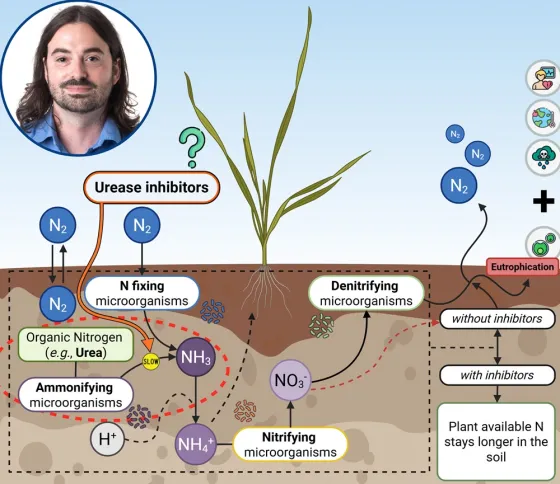
Abstract - Nitrogen pollution stands as one of today’s most pressing global challenges, exerting detrimental effects on the environment, agricultural productivity, and human health. While the development of new, efficient strategies, e.g., novel fertilizers and inhibitors, holds promise for mitigation, their impacts on both plant physiology and associated microbial communities remain poorly understood. This PhD research examines the molecular and microbial mechanisms underpinning nitrogen acquisition in wheat, with a focus on signalling processes between the plant and its rhizosphere microbiome and their modulation by novel urease inhibitors. For this, a multi-omics strategy was employed, integrating high-throughput plant phenomics, targeted GC–MS–based metabolomics, and shotgun metagenomic profiling aiming at resolving key signalling metabolites and microbiome functional shifts and elucidating plant–microbe–metabolite interactions.
A panel of eight novel urease inhibitors was evaluated against a commercially available inhibitor, N-(n-butyl) thiophosphoric triamide, revealing two standout candidates: a substituted dihydroxybenzene and a hydantoin derivative. These compounds emerged as the most promising for further development, offering potential to inform and enhance sustainable nitrogen use efficiency in agricultural systems.
Location
Eucalyptus Seminar Room,
Rm S205, Level 2
RN Robertson Building (46)
Please click the link below to join the webinar:
https://anu.zoom.us/j/81998507505?pwd=CBwrjIPgxmTUy4G52OrPqgPf6OObgb.1
Webinar - 819 9850 7505
Passcode - 014267