
E&E PhD Exit Seminar: New Phylogenetic Methods to Understand Hybridisation
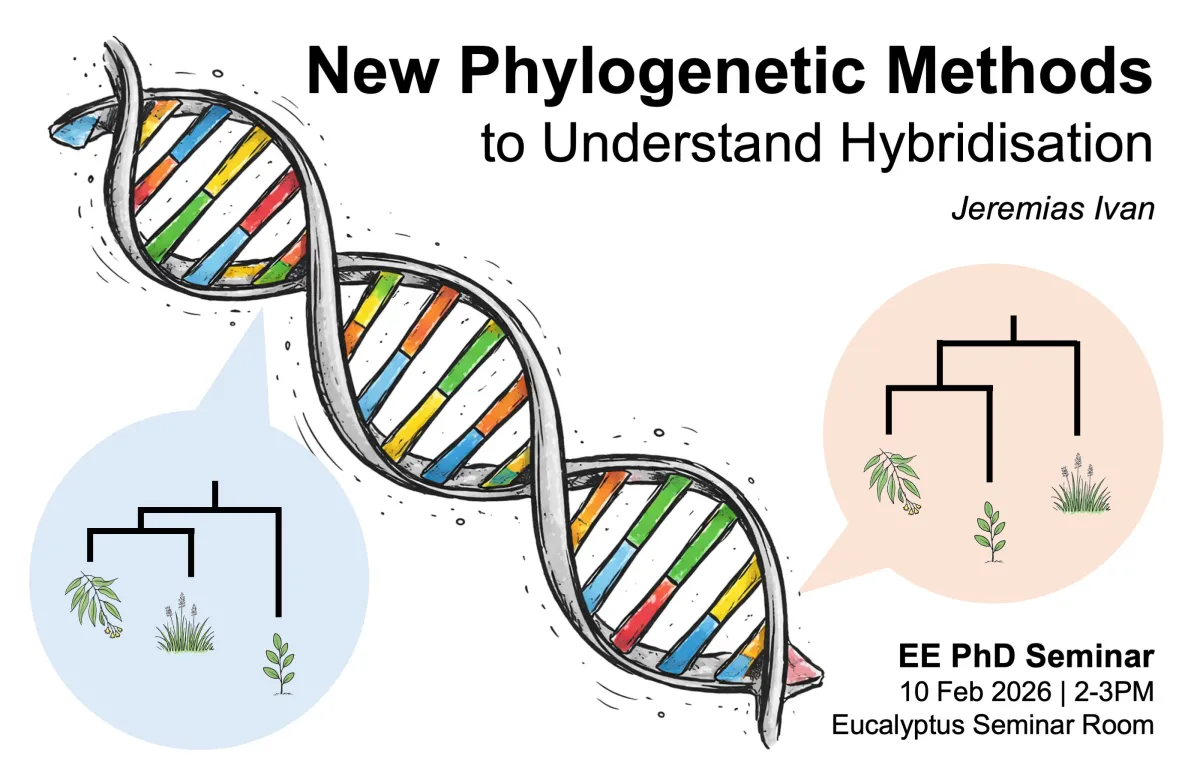
Hybridisation events – together with other biological processes such as recombination and incomplete lineage sorting – can create gene tree discordance, where different genomic regions describe different evolutionary histories.
Speakers
Event series

Content navigation
Description
ABSTRACT
Hybridisation events – together with other biological processes such as recombination and incomplete lineage sorting – can create gene tree discordance, where different genomic regions describe different evolutionary histories. Accurate estimation of these local histories thus depends on both the quality of the sequence data and the robustness of the methods being used.
In the first two chapters, I focused on improving window size selection in non-overlapping window method that is commonly-used to address gene tree discordance. I showed that the AIC (Akaike Information Criterion) provides a less arbitrary way to select the best window size(s) given the alignment, thus better-reflect the recombination patterns across the chromosomes. In Chapter III, I developed a phylogenetic approach that leverages multiple reference genomes to detect reference bias at individual loci. Using a phylogenomic dataset from nine Eucalyptus species, I demonstrated that removing those putatively-biased loci can improve species tree inference of the group. In the final chapter, I assessed the role of phylogenetic distance as a barrier to hybridisation in Eucalyptus globulus. Using 1,000 BUSCO (Benchmarking Universal Single-Copy Orthologs) loci, I found a significant correlation between past and present-day hybrid compatibilities of the species, reflecting a persistent role of phylogenetic distance in shaping the hybridisation patterns of the group.
Overall, these chapters highlight the challenges of assessing hybridisation using phylogenomic datasets. In response, I proposed two phylogenetic methods and presented one case study that together provide a useful framework for future phylogenomic analyses.
BIOGRAPHY
Jeremias Ivan is a bioinformatician who is interested in using phylogenetics to inform conservation efforts. His interest grew during his undergraduate studies in Indonesia, where his thesis focused on the phylogeography and molecular evolution of Australian Eugongylinae skinks. After graduating in 2020, Jeremias worked as a software engineer before starting his PhD in 2022. He is now working on phylogenetic methods to investigate hybridisation, particularly in Eucalyptus, under the supervision of Rob Lanfear, Minh Bui, and Justin Borevitz.
Location
Please note: this seminar will be held in the Eucalyptus Seminar Room and via Zoom, details are included below.
Eucalyptus Seminar Room, S205,
Level 2, RN Robertson Bldg (46)
Please click the link below to join the webinar:
https://anu.zoom.us/j/83018472041?pwd=75PgsabetIzuw3lLinci2mCV2dyc9o.1
Webinar ID: 830 1847 2041
Passcode: 329758
Canberra time: please check your local time & date if you are watching from elsewhere.
Upcoming events in this series

Australia’s alpine regions are known for their rapidly changing weather, cold, snowy winters, clear running streams and wonderfully unique biodiversity. However, things won’t be this way forever, with future climates predicted to challenge plant communities through warmer soils, more frequent droughts and heatwaves, and potentially greater exposure to frost as snow cover declines.